Many homeowners regularly ask if they need to call a technician or if they can handle aircon maintenance themselves.
At Coolbest Aircon Servicing, our founding mission has always been to deliver reliable, high-quality cooling solutions to communities across Singapore at affordable rates.
Through this daily work across the island, we see exactly where DIY efforts succeed and where they cause expensive damage.
Data from the National Environment Agency (NEA) shows air conditioning accounts for roughly 24% of a typical Singaporean household’s electricity consumption.
Finding ways to safely maintain your unit is a highly effective financial strategy.
This guide breaks down the core debate of DIY vs Professional Aircon Servicing: What Can You Do Yourself?
Let us look at the practical steps you can take today and the specific times you absolutely need to call in an expert.
What You Can Safely Do Yourself
These maintenance tasks require no technical expertise and carry minimal risk of damaging your aircon.
You only need basic household items to complete them.
1. Cleaning the Air Filters
This is the single most impactful thing you can do for your aircon at home.
Dirty filters are responsible for the majority of common aircon problems.
These issues include reduced cooling efficiency, higher electricity bills, and even unexpected water leaks.
The US Department of Energy states that replacing a dirty filter with a clean one can lower an air conditioner’s energy consumption by 5% to 15%.
Our technicians highly recommend keeping a regular cleaning schedule.
How to do it:
- Switch off the aircon and unplug it if possible.
- Open the front panel by lifting it gently from the bottom.
- Slide out the mesh filters carefully.
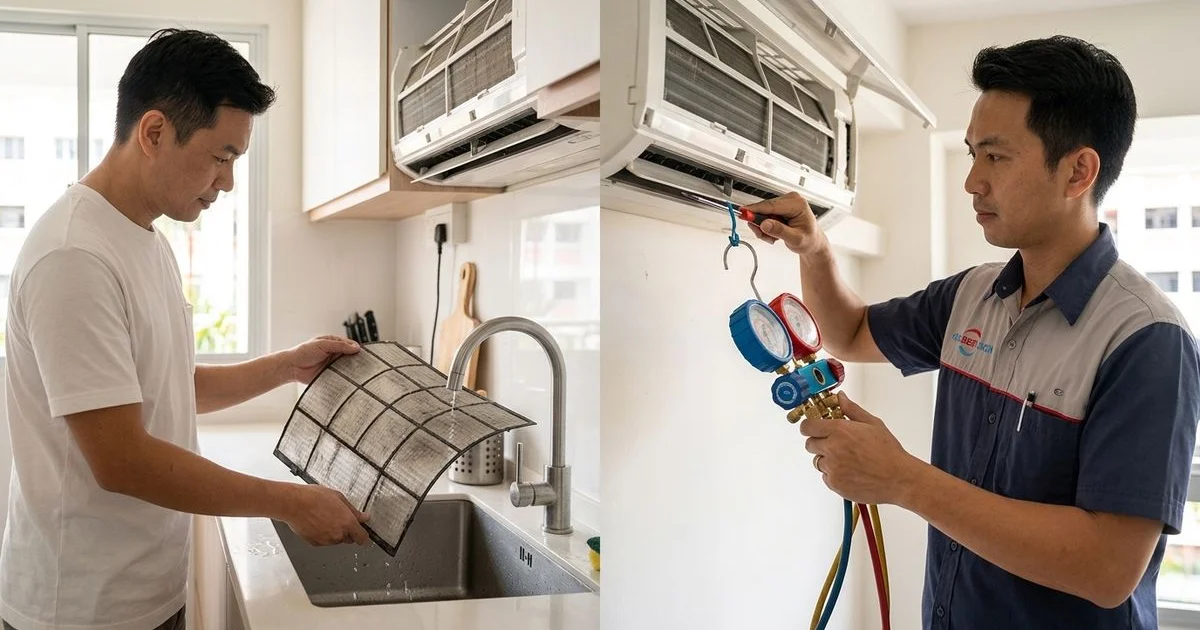
- Rinse the filters under running water and use a soft brush for heavy dust.
- Let the filters air dry completely before reinstalling them.
- Slide the dry filters back into position and close the panel.
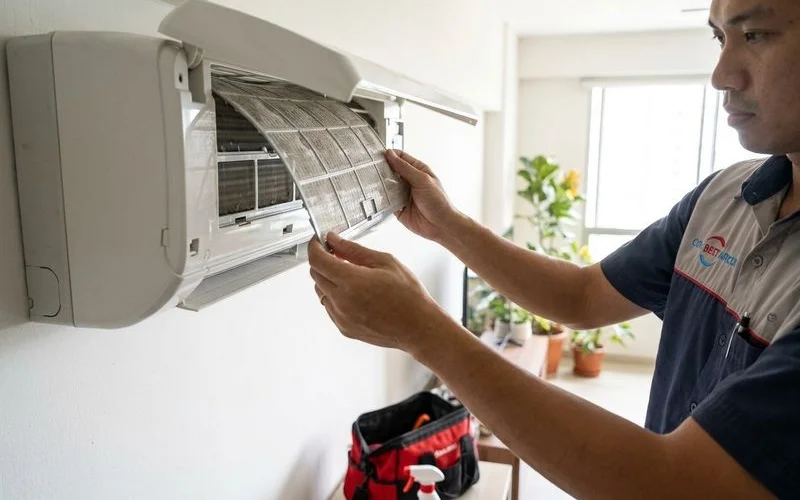
This simple process takes about 10 minutes per unit.
You will notice a genuine difference in cooling performance and indoor air quality immediately.
Heavy users should do this every two weeks.
2. Cleaning the Front Panel and Casing
Dust accumulates on the exterior of your indoor unit rapidly.
This buildup is particularly noticeable on top of the unit and around the air outlet vents.
A dusty casing means more debris gets pulled into the internal system.
We suggest using a microfibre cloth for this task.
Microfibre materials are proven to trap significantly more dust and allergens than standard cotton rags.
How to do it:
- Turn off the unit completely.
- Wipe the exterior with a slightly damp microfibre cloth.
- Use a soft, dry cloth to wipe the delicate air outlet vents.
- Apply a heavily diluted mild detergent for stubborn stains.
Clean the casing once a month or whenever you notice visible dust.
3. Checking the Remote Control
Always check the basics before calling a technician because your aircon is unresponsive.
Alkaline batteries typically have a long shelf life but drain much faster in Singapore’s high humidity.
Our customer service team fields dozens of repair requests every month that turn out to be simple remote issues.
Check these items first:
- Replace the remote batteries with fresh ones.
- Make sure the unit is set to the correct cooling mode.
- Verify the temperature is set correctly.
- Check that the built-in timer is not accidentally activated.
- Ensure nothing is blocking the remote sensor on the unit.
4. Clearing the Area Around the Outdoor Unit
Your outdoor compressor unit needs adequate airflow to dissipate heat effectively.
The system has to work much harder if it is surrounded by clutter or overgrown plants.
Blocked airflow can reduce a condenser’s efficiency by up to 30% according to industry standard efficiency ratings.
We often find that clearing the surrounding area solves mild cooling issues instantly.
How to do it:
- Clear at least 30cm of space on all sides of the outdoor unit.
- Remove any leaves, twigs, or debris from the top and sides.
- Make sure absolutely nothing is blocking the main fan outlet.
- Trim back any plants or bushes growing too close.
Perform a visual check monthly or after heavy storms.
5. Setting Energy-Efficient Temperature
This practice reduces daily strain on your unit significantly.
The NEA recommends setting your aircon to 25°C for optimal efficiency.
Each degree below that target increases energy consumption by roughly 3% to 5%.
Using your aircon’s built-in sleep mode avoids running the unit unnecessarily at maximum capacity.
This simple habit reduces mechanical wear and extends the time between required professional servicing.
What You Should NEVER Do Yourself
Some tasks seem tempting to handle independently but often lead to severe damage or voided warranties.
These specific repairs require a qualified technician with the right diagnostic tools and safety training.
1. Cleaning the Evaporator Coil
The evaporator coil is the delicate aluminium fin structure behind your filters.
It is where the actual heat exchange happens.
This component accumulates a layer of sticky grime over time that standard filters simply cannot catch.
The aluminium fins are typically only 0.1mm thick and are incredibly fragile.
Even light finger pressure can bend them and restrict critical airflow permanently.
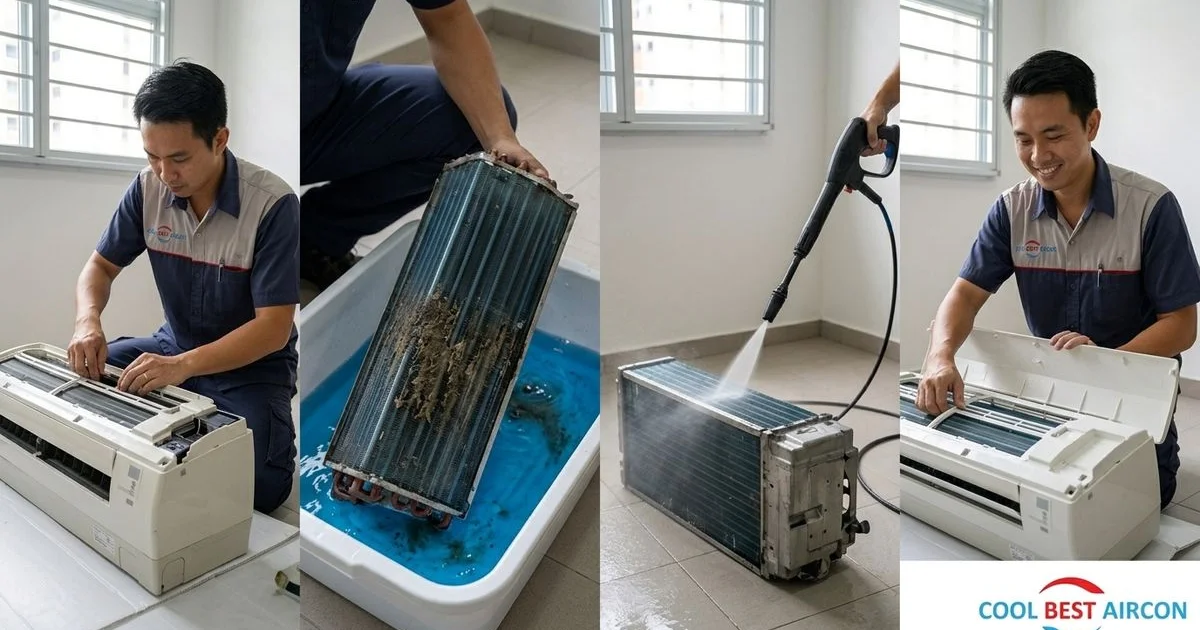
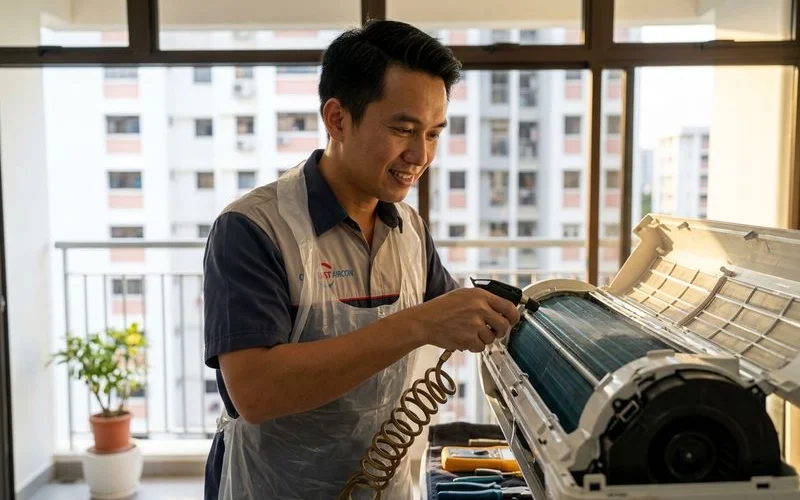
Professional technicians use specialised coil cleaners and carefully controlled water pressure to clear the grime safely.
2. Flushing the Drainage Pipe
A blocked drainage pipe is the most common cause of water leaking from your aircon.
It seems like a simple plumbing job at first glance.
The drainage system actually runs from the indoor unit through your wall and exits outside.
Improper clearing attempts often push thick biological blockages deeper into the narrow 16mm PVC pipe.
Professionals use industrial vacuum pumps or compressed air to ensure the entire pipe is clear.
3. Handling Refrigerant (Gas)
If your aircon is not cooling properly despite clean filters, low refrigerant might be the actual cause.
Some enthusiastic DIYers consider buying gas top-up kits online.
Modern R32 refrigerant operates under extreme high pressure and is mildly flammable.
Incorrect handling can cause severe frostbite burns or release environmentally harmful greenhouse gases.
A professional gas top-up always includes precise leak detection.
4. Electrical Repairs
Do not attempt to open the unit if your aircon is short-cycling or making loud buzzing sounds.
The Singapore Civil Defence Force (SCDF) consistently lists faulty electrical appliances as a leading cause of residential fires.
Aircon units operate on dedicated high-voltage electrical circuits.
Internal capacitors can store lethal electrical charges long after the unit is unplugged.
Electrical testing and component replacement must be left to trained experts.
5. Chemical Wash or Overhaul
Some online tutorials make chemical washing look incredibly straightforward.
They often suggest simply spraying a harsh cleaning solution on the coils and rinsing it off.
The chemical solutions required are highly corrosive alkaline mixtures.
Improper rinsing leaves a toxic residue that eats through copper piping in a matter of months.
A proper chemical overhaul involves complete disassembly and safe handling protocols.
6. Dismantling or Moving the Unit
Do not attempt to remove your aircon unit from the wall yourself during renovations.
The unit is connected directly to copper piping containing pressurised refrigerant.
Disconnecting the piping without recovery tools releases this gas illegally into the atmosphere.
Reinstallation requires a heavy-duty vacuum pump to remove non-condensable gases from the lines.
Only a certified technician can safely recover the gas and reinstall the equipment.
The Cost Comparison: DIY vs Professional
Let us look at the actual numbers to understand the true financial value equation.
Tracking your costs helps clarify why a hybrid approach works best.
DIY Maintenance Routine
Handling basic cleaning at home costs nothing but a few minutes of your time.
| Task | Estimated Cost | Time Required |
|---|---|---|
| Filter cleaning (monthly) | Free | 10 min/unit |
| Panel wiping (monthly) | Free | 5 min/unit |
| Outdoor unit clearing (monthly) | Free | 10 min |
| Total annual cost | S$0 | ~4 hours |
Professional Servicing Rates
Expert maintenance requires a financial investment but protects an expensive appliance from early failure.
| Task | Estimated Cost | Recommended Frequency |
|---|---|---|
| General servicing (per unit) | S$30 to S$50 | Quarterly |
| Chemical wash (per unit) | S$80 to S$120 | Annually |
| Gas top-up (if needed) | S$80 to S$200 | As needed |
The Combined Approach
The smartest long-term strategy is to combine both methods actively.
Your diligent DIY maintenance between professional visits heavily extends the life of each service.
This regular upkeep keeps your aircon running efficiently and prevents small dust issues from becoming major clogs.
Our technicians appreciate servicing well-maintained units because it allows us to focus on vital mechanical checks.
Think of it like standard dental care.
You brush your teeth daily at home, but you still visit the dentist every six months for a professional cleaning.
When to Call a Professional Immediately
Some operational situations require urgent technical attention to prevent catastrophic failure.
Do not attempt to diagnose or patch these specific warning signs yourself.
Ignoring a tripped electrical breaker could mean a failing S$400 compressor needs immediate rescue.
Watch out for these critical issues:
- Water actively dripping from the indoor unit onto your interior walls or floor.
- A distinct burning smell or visible smoke coming from the unit.
- The main circuit breaker tripping the moment the aircon turns on.
- Complete unit failure with absolutely no response to the remote control.
- Loud grinding or metallic screeching noises during operation.
- Thick ice formation visible on the evaporator coil or external copper piping.
These exact issues indicate complex problems that escalate rapidly if ignored.
Booking a same-day service call often prevents these minor issues from becoming expensive total system failures.
Building a Maintenance Routine
Here is a highly practical schedule that combines DIY efforts and professional servicing.
Following this timeline delivers the absolute best results for residential systems.
Every 2 Weeks
- Clean or gently wash the internal air filters (DIY)
Every Month
- Wipe down the front panel and plastic casing (DIY)
- Check and carefully clear the outdoor unit area (DIY)
Every 3 Months
- Schedule Professional general servicing to cover everything you cannot safely do at home
Every 12 to 18 Months
- Book a targeted Chemical wash for a deep cleaning to maintain long-term performance
As Needed
- Request a Gas top-up if cooling feels weak immediately after a standard servicing
- Schedule a Chemical overhaul for seriously neglected or older units
For specific tips on the ideal servicing frequency based on your exact usage habits, read our guide on how often you should service your aircon.
The Bottom Line
You can and absolutely should handle basic aircon maintenance at your own home.
Cleaning filters, wiping dusty surfaces, and keeping the outdoor compressor clear are simple, high-value tasks.
These minor efforts make a measurable difference in daily performance and electrical efficiency.
A professional technician is absolutely essential for anything involving the internal components, refrigerant gas, electrical systems, or chemical solutions.
The cost of routine professional servicing is minimal compared to repairing severe damage caused by incorrect DIY attempts.
We strongly encourage all our customers to maintain their units between our scheduled visits.
This partnership makes our job much easier and keeps your system running better for years to come.
Our expert technicians will handle the complicated mechanical work with care and provide our standard 90-day service warranty.
Need reliable professional servicing today?
Please Contact us at 9182 5233 to secure a same-day service appointment anywhere across Singapore.
Coolbest Team
Coolbest Aircon Editorial Team
The Coolbest Aircon team shares practical tips from our 18+ years of air conditioning service experience in Singapore.