You already know that cooling your Singapore home takes a massive bite out of your monthly budget. We see this frustration every day at Coolbest Aircon Servicing. Many homeowners watch their SP Group bills climb and assume it is just the price of living in a tropical climate.
That assumption is costing you money.
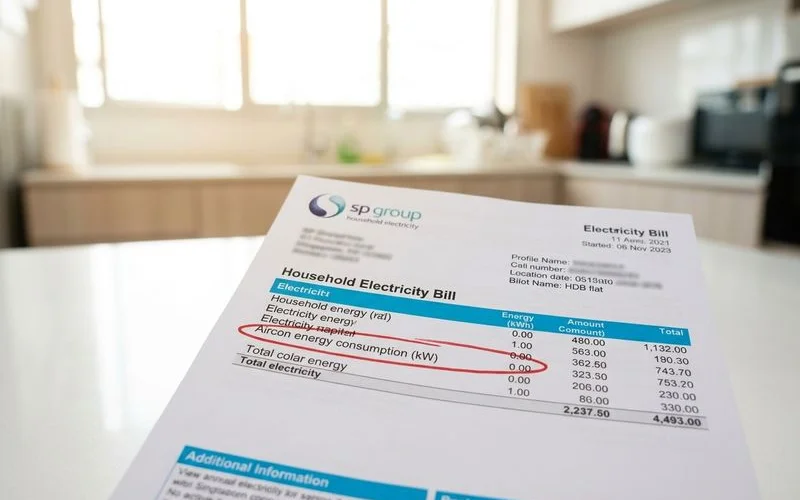
According to the National Environment Agency (NEA), air conditioning accounts for approximately 24% to 30% of a typical household’s electricity consumption. In homes where units run overnight, that share jumps much higher. The current SP Group tariff hovers around 30.65 cents per kWh, meaning a neglected system drains your wallet faster than ever.
The carbon tax increase in 2026 is pushing utility costs up further.
Let us look at the data to see what your cooling system is actually costing you. Then, we will show you the exact maintenance steps to lower your electricity bill and keep more money in your pocket.
How a Dirty Aircon Wastes Electricity
To understand why maintenance saves cash, you need to look inside a neglected unit.
Clogged Air Filters
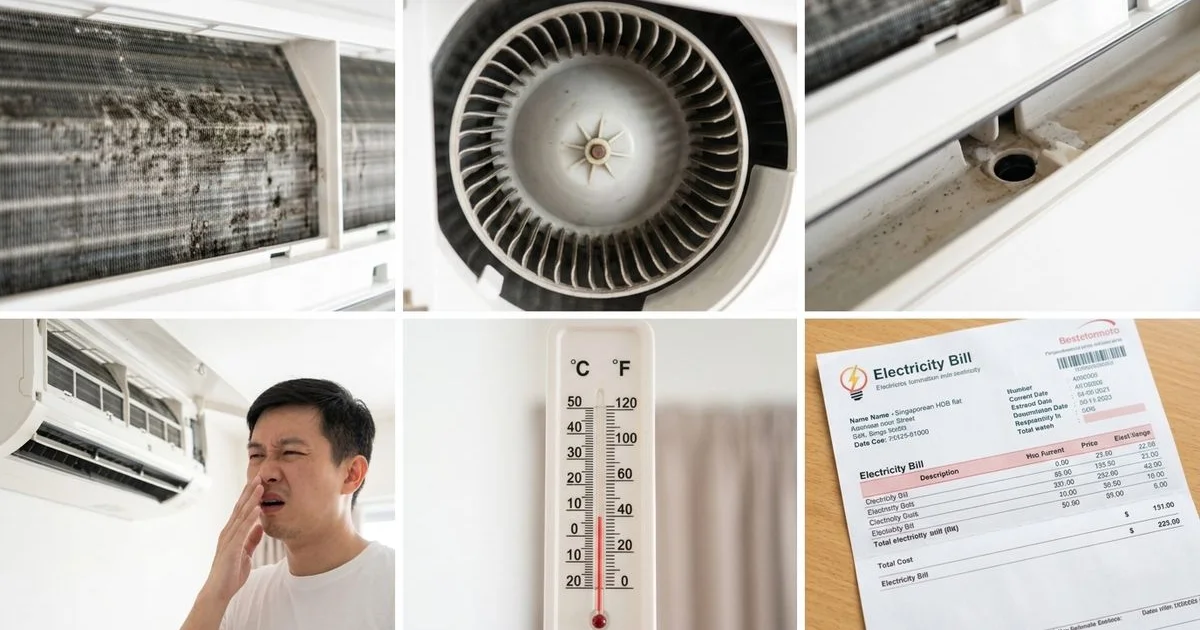
When your air filters are full of dust, airflow through the unit drops sharply. The evaporator coil receives less warm air to cool down. This forces your system to work overtime.
- The compressor runs much longer to achieve your set temperature.
- The fan motor uses extra power to push air through the physical resistance.
- The room simply takes longer to cool down.
- The unit might never reach the target temperature, running continuously.
Our technicians frequently see clogged filters increase energy consumption by 15% to 25%. This single issue turns a highly efficient inverter into a major power drain.
Dirty Evaporator Coil
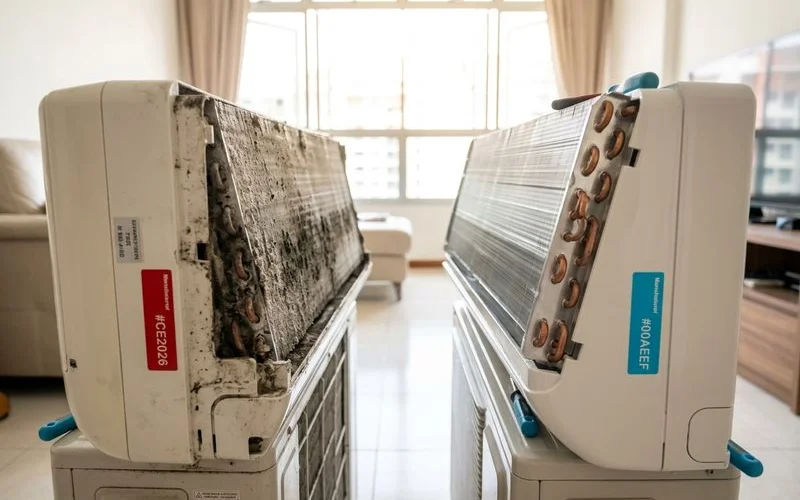
Even if you wash your filters, fine particles eventually coat the indoor evaporator coil. This grime creates a literal blanket of insulation between the cold refrigerant and the room air.
The coil loses its ability to absorb heat efficiently.
- Heat exchange drops rapidly, meaning the output air feels weak.
- The compressor compensates by extending its cooling cycles.
- Energy waste scales up directly with the thickness of the dirt layer.
A heavily coated coil easily adds another 10% to 15% to your energy consumption. You are paying for electricity that never actually cools your room.
Low Refrigerant Levels
Refrigerant is the chemical blood of your cooling system. It physically absorbs heat from your bedroom and releases it outside.
If a slow leak lowers this gas level, the heat transfer process breaks down.
The compressor pumps furiously but generates very little cold air. A timely gas top-up corrects this imbalance and restores efficient cooling. Low refrigerant can spike your energy consumption by 10% to 20%. It also leaves your family sweating in a warm room.
Blocked Drainage
A clogged condensate pipe does not draw extra electricity directly. It does, however, create a chain reaction of mechanical failures.
Water backs up into the drainage tray and can spill onto vital electrical components.
In severe cases, the trapped moisture causes thick ice to form directly on the evaporator coil. This ice blocks airflow completely and triggers rapid, wasteful compressor cycling.
The Combined Effect
These mechanical problems rarely happen one at a time. A neglected unit usually suffers from dusty filters, a grimy coil, and slowly dropping gas pressure all at once.
We routinely measure a 15% to 25% difference in electricity consumption between a serviced unit and a dirty one. The Energy Market Authority (EMA) even points to unmaintained air-conditioning as a primary culprit for high energy use across Singapore.
The cumulative penalty on your monthly SP Group bill is massive. In extreme cases of neglect, the efficiency loss climbs even higher.
“A properly maintained cooling system does not just improve comfort. It actively protects you from the compounding costs of wasted electricity.”
What the Savings Actually Look Like
Let us put real numbers to these percentages. The SP Group tariff for early 2026 sits at approximately 30.65 cents per kilowatt-hour.
Here is how a dirty system drains your funds.
Average Singapore Household
| Parameter | Value |
|---|---|
| Monthly electricity bill | S$200 - S$300 |
| Aircon share (~30%) | S$60 - S$90 |
| Electricity wasted by neglected aircon (20%) | S$12 - S$18/month |
| Annual waste | S$144 - S$216 |
For a 5-Room HDB with System 4
| Parameter | Value |
|---|---|
| Monthly electricity bill | S$250 - S$350 |
| Aircon share (4 units, heavy use) | S$80 - S$120 |
| Electricity wasted by neglected aircon (20%) | S$16 - S$24/month |
| Annual waste | S$192 - S$288 |
Cost of Servicing vs Savings
| Service | Annual Cost | Annual Savings |
|---|---|---|
| Quarterly general servicing (4 units) | S$320 - S$480 | S$144 - S$288 |
| Annual chemical wash (4 units) | S$280 - S$400 | Additional improvement |
| Total maintenance | S$600 - S$880 | S$144 - S$288 |
Our data shows that electricity savings alone recover 25% to 50% of your servicing costs. When you factor in the high price of emergency repairs, routine maintenance pays for itself.
What Servicing Does to Improve Efficiency
Here is exactly what happens during a professional maintenance visit to lower your bills.
During General Servicing (Every 3 Months)
A standard service tackles the surface-level buildup that chokes your system.
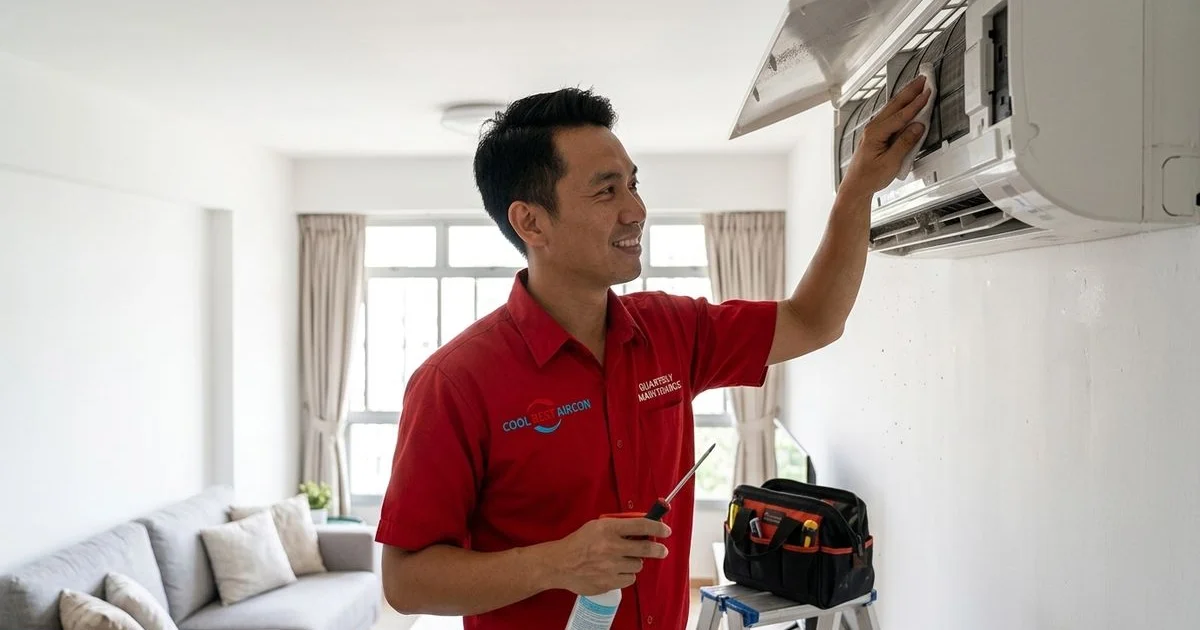
- Filter cleaning: Washing the filters restores immediate airflow. This is the single biggest energy saver in routine maintenance.
- Coil surface cleaning: Technicians wipe down the accessible metal fins of the evaporator coil. This removes the light dust that insulates the cold refrigerant.
- Drainage clearing: Flushing the pipe ensures condensation flows away smoothly. This prevents the ice buildup that cripples cooling efficiency.
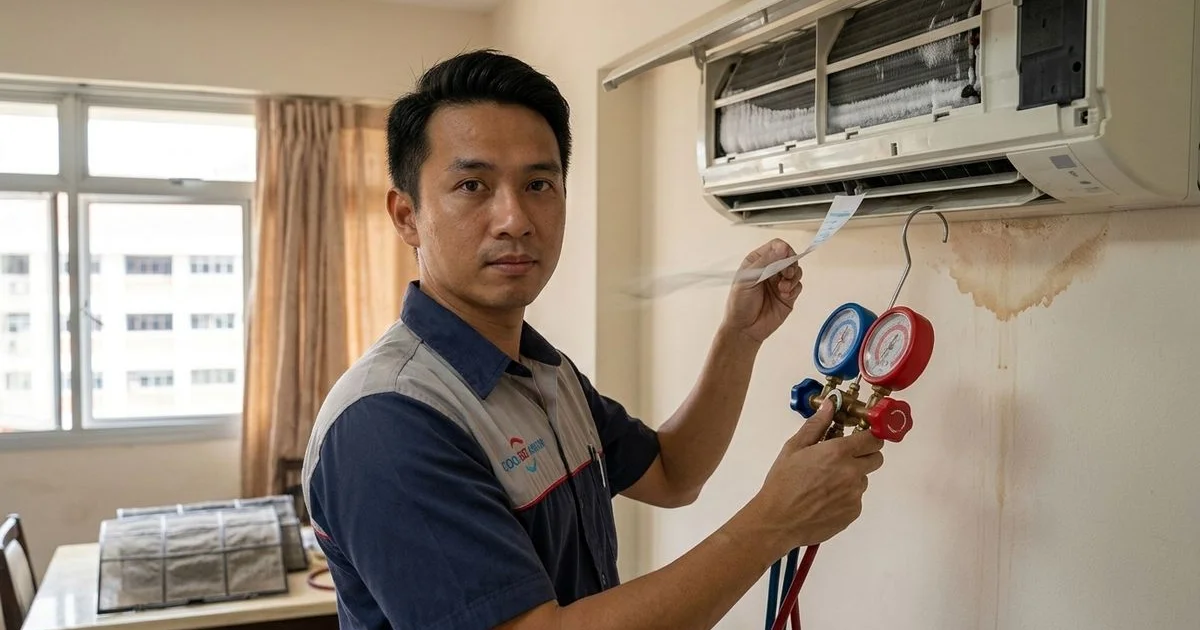
- Refrigerant check: Checking the gas pressure catches slow leaks early. We fix these minor drops before they force your compressor to overwork.
- Thermostat verification: Testing the sensors confirms accurate temperature readings. A faulty thermostat easily wastes electricity by overcooling the room.
During Chemical Wash (Every 12-18 Months)
A chemical wash goes far deeper than a standard wipe-down.
The targeted chemical solution dissolves the stubborn, embedded grime deep inside the evaporator coil. Routine brushing simply cannot reach this hardened layer of dirt.
By stripping the coil down to bare metal, we restore the system to its original heat exchange capacity.
Many homeowners notice their rooms cool down significantly faster after this procedure. The compressor runs much shorter cycles, dropping power usage instantly. You can read our detailed breakdown on whether a chemical wash is worth the cost to see the full financial impact.
How to Maximise Energy Savings Beyond Servicing
Professional maintenance forms the foundation of an efficient home. You can multiply those savings by adopting a few smart daily habits.
Set the Right Temperature
The NEA firmly recommends 25°C as the optimal temperature for both comfort and efficiency.
Every single degree you drop below 25°C increases your energy consumption by roughly 3% to 5%.
| Temperature | Energy Penalty (vs 25°C) |
|---|---|
| 25°C | Baseline Efficiency |
| 24°C | +3% to 5% |
| 23°C | +6% to 10% |
| 22°C | +10% to 15% |
| 20°C | +15% to 25% |
Setting your remote to 25°C instead of 22°C easily saves S$10 to S$20 per month. That translates to a totally free S$120 to S$240 saving every year.
Leverage Smart Remote Features
Modern remotes offer specific settings designed to cut power usage.
Daikin, for example, includes an “ECONO Mode” that physically limits the compressor’s maximum capacity to 70%. This prevents the system from drawing huge spikes of electricity when you first turn it on.
You should also utilise the sleep mode or “NIGHT SET” feature. This automatically raises the temperature by 0.5°C to 1°C after you fall asleep. Your body naturally cools down at night, so you will stay comfortable while your SP Group bill drops.
Use Fan Mode Strategically
Running your unit in “Fan Mode” uses a tiny fraction of the electricity compared to the standard cooling mode.
In Fan Mode, the power-hungry compressor stays completely off. The unit simply circulates the existing room air. This is perfect for breezy evenings or for spreading cool air around after the compressor has already done its job.
As another option, pairing a ceiling fan with your cooling system allows you to set the thermostat 2°C higher. You will feel exactly the same level of comfort for much less money.
Seal the Cooled Space
Leaving a bedroom door cracked open is a massive drain on power.
The system will stubbornly try to cool the adjacent hallway or living room. It will never reach its target temperature and will run the compressor continuously. Keep your windows tight and doors shut to trap the cold air inside.
Use the Timer Function
If you rely on air conditioning to fall asleep, use the built-in timer.
Set the unit to switch off one to two hours before your alarm goes off. The insulated room will stay comfortably cool until morning. You avoid paying for two hours of unnecessary compressor time every single day.
Clean Filters Every Two Weeks
You do not need to wait for your quarterly service to improve airflow.
Washing your own dust screens every two weeks is highly effective. You can learn exactly how to do this in our guide to cleaning your own filters. This simple DIY task protects your compressor and keeps energy usage flat between professional visits.
Consider Your Unit’s Age and Efficiency
Older appliances are notoriously inefficient.
If your system is over a decade old, it likely holds a poor 1 or 2 energy tick rating. The NEA offers $300 Climate Vouchers under the Climate Friendly Households Programme (CFHP) to help owners upgrade to modern 4 or 5-tick units.
These new models can slash cooling costs by 30% to 40%. You can learn more about this in our energy tick rating guide.
For mid-aged units around 7 to 10 years old, a deep chemical overhaul often restores lost efficiency. However, if the hardware is past 12 years, a full replacement usually makes the best financial sense.
Tracking Your Savings
You do not have to guess if these steps are actually working. You can track the real-world impact on your monthly expenses.
Our clients often see a sharp drop in their power usage immediately following a thorough cleaning.
Here is the best way to monitor your progress:
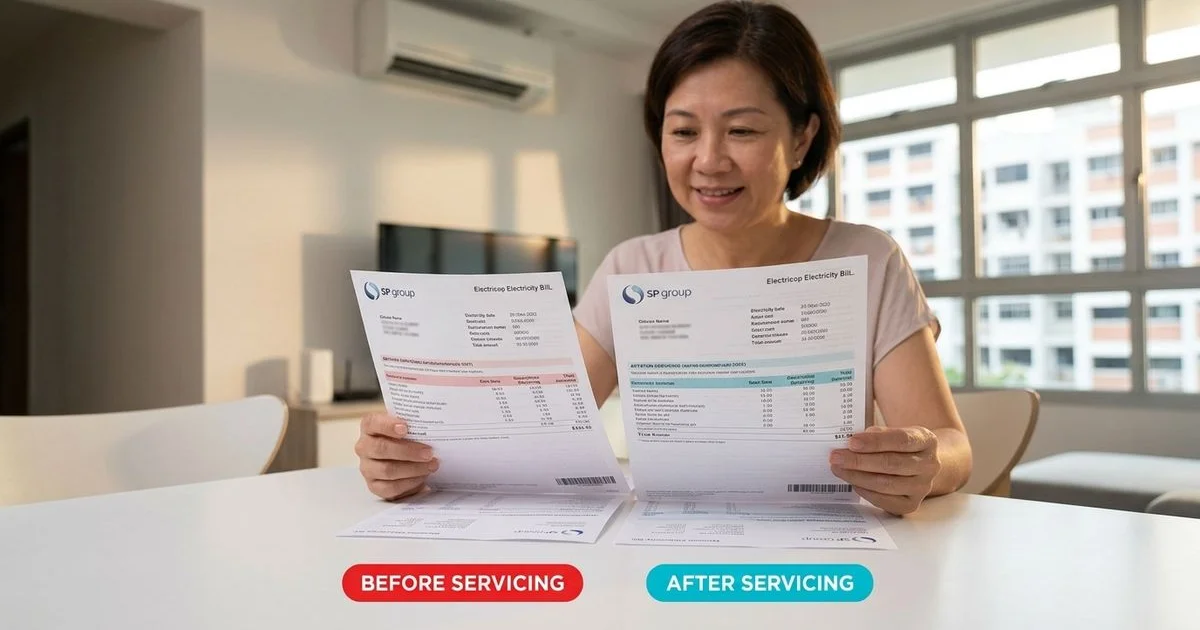
- Record your baseline SP Group bill before maintenance. Look specifically at your total kWh consumption, as dollar tariffs fluctuate quarterly.
- Book your maintenance at a consistent time. Schedule visits for the same month each quarter to establish a routine.
- Compare identical months year-over-year. Match September 2025 against September 2026 to rule out seasonal heat waves.
- Account for lifestyle changes. Buying a new refrigerator or working from home more often will naturally increase your baseline usage.
The Long-Term Perspective
Consistent maintenance provides financial benefits that compound year after year. A clean unit operating at peak efficiency over a 12-year lifespan uses drastically less power than a neglected machine. When you add up the monthly electricity savings, the delayed replacement timeline, and the avoided emergency repairs, the total value reaches thousands of dollars.
We design every maintenance visit to maximise your system’s efficiency. The technicians refuse to just spray water and leave, choosing instead to carefully measure your gas pressure, test your thermostat, and verify that your compressor is operating flawlessly. Every service we provide includes completely transparent pricing and a solid 90-day warranty.
Are you ready to stop overpaying for electricity? Contact us at 9182 5233 to schedule your next appointment, or review our pricing page to see our current rates.
Mr Chong
Founder & Lead Technician
Mr Chong founded Coolbest Aircon in 2005 with over 18 years of hands-on aircon servicing experience in Singapore.