Choosing a new cooling system is a major commitment that directly impacts your monthly utility bills. We see homeowners constantly underestimate how much a slightly cheaper upfront choice costs them over a decade at Coolbest Aircon Servicing. This common mistake leads to years of inflated utility bills. Our team was founded with a mission to deliver reliable, high-quality cooling solutions to communities across Singapore at affordable prices. That specific experience has shown us exactly what works and what fails in local housing estates.
We know you will live with this decision for the next 10 to 15 years. A multi-split setup can easily cost S$2,500 to S$6,000 to get running. Our technicians want to ensure your investment guarantees comfortable, energy-efficient cooling. Getting it right is easier when you understand the foundational data. This comprehensive How to Choose the Right Aircon for Your HDB Flat (2026 Guide) breaks down everything from precise sizing to the specific installation factors unique to Singapore apartments.
Step 1: Understand System Types for Your HDB Flat
In Singapore, apartments almost exclusively rely on multi-split or single-split configurations. Here is a clear breakdown of what each category actually means for your space.
Single-Split System (System 1)
This setup connects one outdoor compressor to exactly one indoor blower. Single splits work perfectly for studio units or adding dedicated cooling to a single unlinked bedroom.
Multi-Split Systems (System 2, 3, 4, 5)
We install these configurations daily. One heavy-duty outdoor unit powers multiple indoor wall units across your home. The number immediately following “System” tells you exactly how many indoor units you can run simultaneously.
| System | Indoor Units | Best For |
|---|---|---|
| System 1 | 1 | Studio, single room |
| System 2 | 2 | 2-room or 3-room flat |
| System 3 | 3 | 4-room flat |
| System 4 | 4 | 5-room flat |
| System 5 | 5 | Executive flat, maisonette |
Pro Tip: Most standard 4-room BTO flats default to a System 3 configuration covering the master bedroom, common room, and living area.
The outdoor compressor for a multi-split setup is significantly larger than a single split model. HDB regulations strictly mandate that outdoor units cannot exceed specific structural weight limits, capped securely at 80kg for standard ledges. You must ensure your designated ledge can safely handle the exact dimensions and weight of your chosen model, as older blocks often have tighter spatial constraints compared to newer estates.
Step 2: Calculate the Right BTU for Each Room
British Thermal Units (BTU) measure the actual cooling capacity of your equipment. Getting this number wrong remains the most common and expensive mistake local homeowners make.
Why Exact BTU Sizing Matters
Selecting a capacity that is too low forces the compressor to run constantly without ever fully chilling the room. This overworks the internal components and dramatically increases your SP Group electricity bills.
Going too high is equally problematic for long-term reliability. The oversized machine chills the space too quickly and cycles off rapidly. This short-cycling fails to remove humidity properly and accelerates wear and tear on the electrical board.
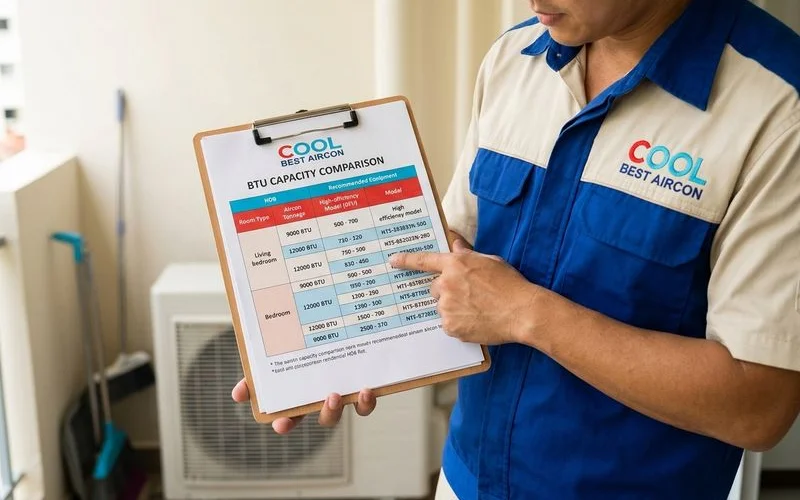
Standard BTU Guide for HDB Rooms
We use a simple calculation based on square metres to get the perfect fit. Here is the baseline capacity you need for standard apartment layouts.
| Room Type | Typical Size | Recommended BTU |
|---|---|---|
| Common bedroom | 8-10 sqm | 9,000 BTU |
| Master bedroom | 12-15 sqm | 12,000 BTU |
| Living room (4-room) | 20-25 sqm | 18,000-21,000 BTU |
| Living room (5-room) | 25-30 sqm | 21,000-24,000 BTU |
| Kitchen (if cooling) | 8-12 sqm | 9,000-12,000 BTU |
Environmental Factors That Increase Heat Load
Standard calculations only work for perfectly shaded spaces. You must increase your baseline BTU by 10% to 15% if any of these conditions apply to your property:
- West-facing walls: Afternoon sun bakes the concrete and creates a massive heat load.
- High floors (above 15th storey): These units lack shade from neighbouring buildings and absorb direct sunlight.
- Extensive glass panels: Large windows invite significant thermal heat gain.
- Open-concept kitchens: Heat from gas hobs spills directly into adjacent living spaces.
Many buyers grab the cheapest bundle deal without verifying individual blower capacities. A budget System 3 offering 9,000 BTU per blower works for bedrooms but fails miserably in a 25 sqm living area. Ensure your contractor matches each indoor blower specifically to the room it serves.
Step 3: Choose the Right Brand
Japanese manufacturers continue to dominate the local market, though a few Korean and Chinese companies provide strong alternatives. Our technicians service all these machines regularly. We have seen clear patterns in reliability and parts availability over the years.
Top Performing Brands for HDB Flats
- Daikin: The clear market leader holds a massive local presence. Their current iSmileEco series uses the highly efficient R32 refrigerant. These models command a premium price but justify it through exceptional energy savings and strong build quality.
- Mitsubishi Electric: This brand stands as the strongest direct competitor to Daikin. The Starmex FN series is practically a household name in Singapore flats, boasting incredibly quiet operation (as low as 19 decibels) and easily detachable parts for cleaning.
- Panasonic: This company delivers an excellent mid-range balance of price and performance. Their proprietary nanoe-X technology actively purifies the indoor air by neutralizing bacteria.
- Midea: This Chinese manufacturer represents the best value choice for budget-conscious families. You will trade slightly higher monthly energy consumption for substantial upfront cash savings.
- LG: The Korean tech giant brings sleek aesthetics and dual-inverter compressor technology. Their ThinQ application offers highly intuitive mobile controls, though their local spare parts network is slightly smaller than the Japanese heavyweights.
For a complete breakdown of the two absolute market leaders, read our detailed Daikin vs Mitsubishi comparison.
Step 4: Understand Energy Tick Ratings
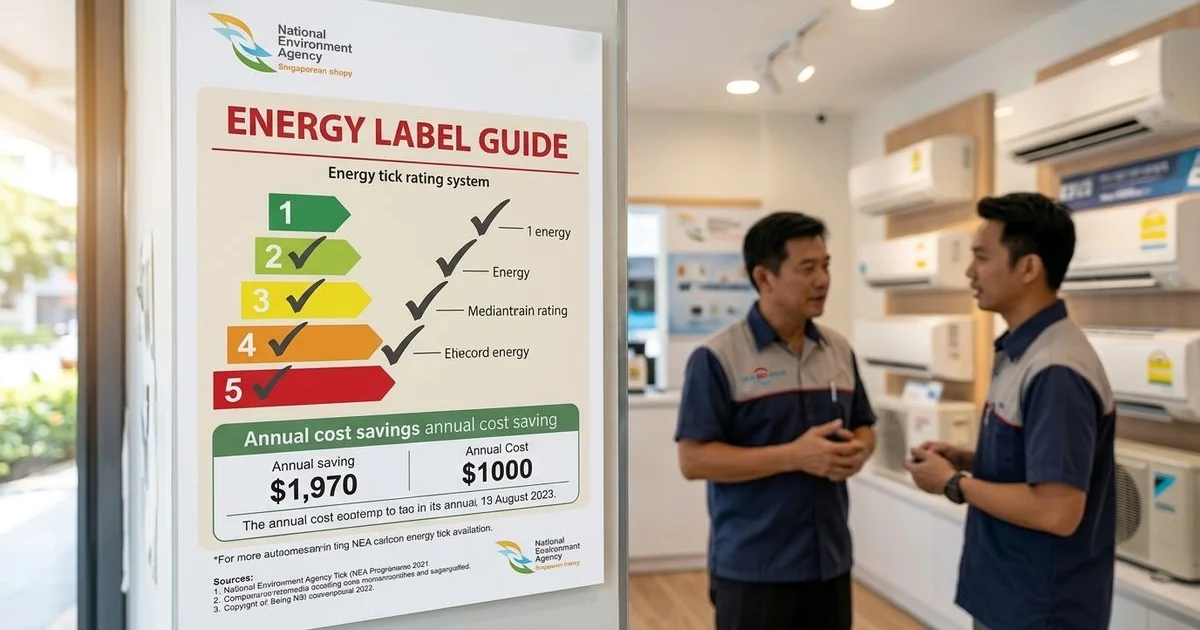
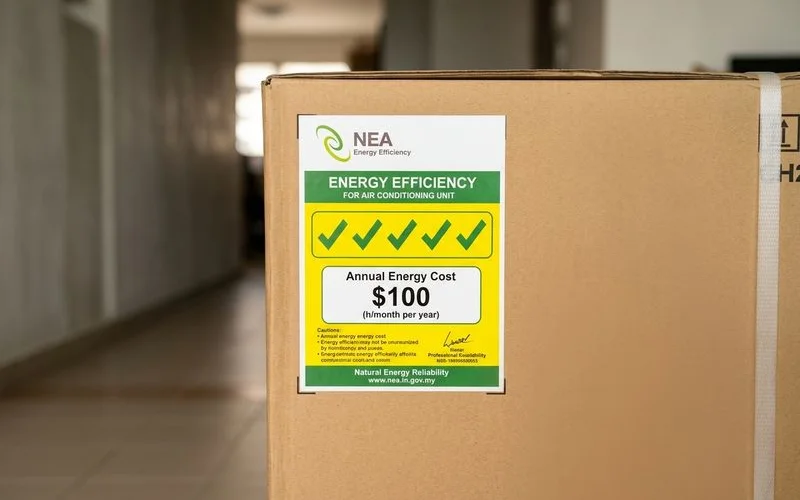
The National Environment Agency (NEA) mandates that every new unit sold locally displays an energy label. This brightly coloured sticker is the single most important indicator of your future running costs.
Decoding the NEA Tick System
We always tell clients to look at the annual energy cost estimate printed right on the label. This figure uses standardised testing parameters to give you a clear, side-by-side comparison.
| Ticks | Efficiency | Annual Energy Cost |
|---|---|---|
| 1 tick | Minimum standard | S$550-700 |
| 2 ticks | Below average | S$450-550 |
| 3 ticks | Average | S$380-450 |
| 4 ticks | Good | S$300-380 |
| 5 ticks | Excellent | S$250-300 |
The stated annual figure assumes standard usage patterns. Your actual SP Group bill depends heavily on your specific target temperature and operating hours.
The Hidden Value of High Efficiency
A top-tier 5-tick model typically costs S$300 to S$500 more at the point of purchase compared to a 3-tick variant. This initial price shock deters many first-time buyers.
That S$500 difference pays for itself rapidly through sustained electricity savings. If a 5-tick machine saves you S$120 annually, you recover the premium in just over four years, and it continues acting as a strict discount on your utilities for the remaining decade of its operational life.
For a complete mathematical breakdown of these savings, review our guide on understanding energy tick ratings.
Step 5: Consider Inverter Technology
Almost all reputable cooling systems sold for residential use today feature built-in inverter technology. If a retailer offers a remarkably cheap fixed-speed alternative, you should strongly reconsider that purchase.
The Inverter Advantage Explained
Traditional non-inverter compressors operate on a simple binary mechanism. The motor runs at absolute maximum capacity until the sensor detects the target temperature, then it powers off completely. This constant hard-starting process draws massive electrical currents and creates noticeable temperature fluctuations.
Modern inverter compressors function much like a car’s accelerator pedal. The internal motor intelligently adjusts its rotational speed to maintain your desired room climate precisely.
- Lower power consumption: Inverters eliminate power-hungry startup spikes, yielding 30% to 50% better efficiency.
- Quieter environments: The compressor rarely runs at maximum noise-producing speed.
- Stable comfort: You avoid the distinct hot and cold patches caused by fixed-speed cycling.
Given our tropical climate and heavy daily usage patterns, this variable-speed technology is essentially mandatory. Choosing older fixed-speed motors guarantees inflated utility statements.
Step 6: Plan Your Installation
Buying a premium machine is completely useless if the physical setup is flawed. The quality of materials used and the technical routing directly dictate how well your investment performs.
Essential HDB Installation Requirements
Our installation crews emphasize proper material specifications over rushing the job. Substandard copper or thin insulation leads directly to severe water leaking issues within months.
- Piping materials: We strongly recommend upgrading to thicker G22 copper pipes and standardising on half-inch Armacell Class 0 insulation. Thicker insulation heavily reduces the risk of condensation forming along your ceilings.
- Trunking versus concealed routing: Exposed PVC trunking running along the walls is the industry standard and remains highly cost-effective. Hiding copper lines inside false ceilings or walls looks flawless but costs double.
- Indoor unit placement: You must position the indoor unit away from direct window sunlight. The unit should be centred on the longest wall of the room for even air distribution.
- Outdoor unit placement: Ensure the compressor has adequate clearance for airflow on all sides on the designated HDB ledge. For multi-split systems, check that the structural ledge can support the heavy weight and physical size of the larger outdoor unit.
- Electrical requirements: Every modern aircon system requires a dedicated 15-amp or 20-amp electrical circuit. Older flats may need a licensed electrician to install an additional circuit directly from the distribution board.
To accurately forecast your required budget, explore our complete installation cost guide.
Step 7: Budget Realistically
Setting clear financial expectations prevents sticker shock at the showroom. Here is a realistic breakdown of complete setup expenses for popular apartment layouts in 2026.
Complete Setup Cost Estimates
| System | Budget Range | Mid-Range | Premium |
|---|---|---|---|
| System 2 | S$1,800-2,500 | S$2,500-3,500 | S$3,500-4,500 |
| System 3 | S$2,500-3,500 | S$3,500-4,500 | S$4,500-5,500 |
| System 4 | S$3,000-4,000 | S$4,000-5,500 | S$5,500-7,000 |
The budget tier typically covers entry-level Midea models carrying 2-tick to 3-tick ratings. The mid-range bracket secures reliable Panasonic equipment. Premium pricing reflects top-tier Daikin or Mitsubishi configurations sporting 5-tick efficiency labels.
Standard Inclusions and Hidden Extras
A legitimate quotation must explicitly list all provided materials. Standard setups should automatically bundle the indoor blowers, the outdoor compressor, basic mounting brackets, and up to 5 metres of trunking.
Crucially, the quote must include vacuuming the copper lines before releasing the R32 refrigerant gas. Skipping this vacuum process leaves moisture in the pipes and instantly voids your manufacturer warranty.
| Add-On | Cost |
|---|---|
| Extra piping (per metre) | S$25-40 |
| Concealed piping | S$200-400 per unit |
| Chemical protection coating | S$50-80 per unit |
| Dedicated electrical circuit | S$150-300 |
| Bracket for replacement | S$80-120 |
Common Mistakes to Avoid
Many buyers repeat the same costly errors simply because they skip the initial research phase. Here are the specific pitfalls we rescue homeowners from regularly.
Critical Errors in Purchasing and Maintenance
- Choosing the cheapest quote without comparing scope: A bid that comes in S$500 below market rate almost certainly cuts corners on material quality. Always compare every single line item.
- Ignoring energy efficiency for upfront savings: That cheap 2-tick system seems like a steal until you receive your utility statement. Think total cost of ownership, not just purchase price.
- Oversizing or undersizing: An oversized unit wastes energy and an undersized one cannot keep up. Follow the BTU guide above or ask your installer to calculate the correct capacity for each room.
- Skipping maintenance after installation: A new aircon needs regular servicing from the start to maintain efficiency and warranty validity. Schedule your first general clean precisely three to four months after the handover date.
- Not checking the installer’s credentials: Make sure your installer is Building and Construction Authority (BCA) registered and carries proper insurance. Using an uncertified handyman exposes you to massive liabilities.
How to Choose the Right Aircon for Your HDB Flat (2026 Guide): Our Final Recommendation
Based on hundreds of successful residential projects, we have a clear blueprint for the average family. A standard 4-room BTO or resale unit requires a very specific approach to maximize efficiency.
- System 3 Configuration: Match 9,000 BTU blowers to the bedrooms and an 18,000 BTU blower to the living space.
- Premium Japanese Brands: Invest in Daikin or Mitsubishi hardware to secure superior long-term reliability.
- Maximum Efficiency: Demand a 4-tick or 5-tick rating to combat rising electricity tariffs.
- Thick Insulation: Specify upgraded half-inch Armacell piping insulation to prevent sweaty walls.
- Certified Professionals: Ensure the chosen company holds active BCA and bizSAFE credentials.
Our team knows this precise combination guarantees rapid cooling and keeps utility expenses highly manageable. The equipment will easily serve your family for well over a decade if you commit to proper maintenance.
Need Help Choosing or Installing?
We supply and professionally mount all major cooling brands for apartment dwellers across the island. The dedicated specialists conduct thorough site assessments to accurately calculate the heat load of your specific rooms. Our team then maps out the cleanest piping routes and provides transparent, itemized quotations.
You receive full manufacturer protection on the hardware alongside our dedicated workmanship guarantee. We schedule subsequent quarterly cleaning packages to ensure your investment continues running flawlessly long after the initial setup.
This How to Choose the Right Aircon for Your HDB Flat (2026 Guide) should help you make an informed decision for your space. Our customer support staff is ready to answer any remaining questions. Contact us at 9182 5233 for a free consultation and quote.
Mr Chong
Founder & Lead Technician
Mr Chong founded Coolbest Aircon in 2005 with over 18 years of hands-on aircon servicing experience in Singapore.