You probably hear the terms R22, R410A, and R32 tossed around during routine maintenance visits. We notice that many property owners only think about these labels when a technician suggests a gas top-up.
Understanding the “R22 vs R410A vs R32 Gas: What is the difference?” debate is crucial because it directly impacts your electricity bills and repair options. Our team knows that choosing the right maintenance path saves serious money over a unit’s lifespan.
Let’s look at the data behind these options and outline exactly how to handle your specific system.
What Is Refrigerant and Why Does It Matter?
Refrigerant is the chemical compound that circulates through your aircon system to absorb heat from indoor air and release it outside. Without this fluid, your expensive unit is just an overgrown fan. It cannot cool the air at all.
We always explain to clients that this refrigerant flows in a closed loop. It absorbs heat as a liquid inside the indoor evaporator unit, travels to the outdoor condenser where it releases the heat, and cycles back. This process repeats continuously while the machine is running.
Air conditioning accounts for roughly 24 percent of the average Singapore household’s electricity consumption. Different refrigerant types operate at different pressures and absorb heat at different rates. The specific type of gas your unit uses was determined at the factory, and you cannot simply swap one for another.
R22 (Freon): The Legacy Gas
What It Is
R22, also known as HCFC-22 or by the brand name Freon, served as the standard refrigerant from the 1960s through the early 2000s. If your home has an air conditioner installed before 2010, it likely relies on this legacy gas.
Key Characteristics
| Property | Value |
|---|---|
| Chemical type | HCFC (Hydrochlorofluorocarbon) |
| Ozone depleting | Yes |
| Global Warming Potential (GWP) | 1,810 |
| Operating pressure | 68 psi (low side) |
| Availability | Decreasing rapidly |
| Top-up cost | S$100 to S$180 per unit |
The Problem with R22
R22 actively depletes the ozone layer. Under the Montreal Protocol, an international environmental agreement, Singapore has strictly regulated this chemical. We have watched the local supply shrink dramatically over the past decade.
Here are the key phase-out milestones:
- 2010: Global production of R22 dropped by 75 percent.
- 2015: Singapore officially banned the import of new R22 equipment.
- 2020: Global R22 production fell by 99.5 percent.
- 2030: Complete global phase-out with zero new production allowed.
As factory production stops, the remaining local supply comes entirely from recycled stock. R22 prices continue to rise rapidly and will only get more expensive as 2030 approaches.
What This Means for You
If your aircon uses R22, the machine itself might still work fine. You will face two increasing financial hurdles as time goes on.
First, standard gas top-ups cost significantly more now due to the dwindling recycled supply. Second, if you face a major repair like a compressor failure, fixing it rarely makes financial sense. Our technicians typically recommend replacing the entire system rather than pouring money into an obsolete R22 setup.
R410A: The Current Standard
What It Is
R410A replaced R22 and became the industry standard for units installed between 2008 and 2020. It is a specific blend of two HFC refrigerants, R32 and R125, mixed in equal proportions. We encounter this gas in a huge percentage of Singaporean HDB flats today.
Key Characteristics
| Property | Value |
|---|---|
| Chemical type | HFC blend (R32 + R125) |
| Ozone depleting | No |
| Global Warming Potential (GWP) | 2,088 |
| Operating pressure | 118 psi (low side) |
| Availability | Widely available |
| Top-up cost | S$80 to S$180 per unit |
Advantages of R410A Over R22
R410A brought several major improvements to the cooling market.
- No ozone depletion: It does not damage the Earth’s ozone layer.
- Higher energy efficiency: It operates at a higher pressure, enabling much better heat transfer.
- Wide availability: Technicians can source this gas easily across Singapore.
- Better performance: It cools rooms noticeably faster than older R22 models.
Limitations of R410A
Despite its popularity, R410A has significant drawbacks that led to newer government regulations.
- High GWP: At 2088, R410A has a massive global warming potential.
- Regulatory bans: The National Environment Agency (NEA) banned the supply of new single-phase aircons using high-GWP refrigerants starting in late 2022.
- Higher operating pressure: It requires thicker copper piping, meaning you cannot refill an old R22 system with R410A.
- Blend complications: Because it is a blend, the lighter R32 component leaks faster if a pipe cracks.
For significant R410A leaks, you cannot just top it up. Our protocol requires technicians to fully evacuate the remaining unbalanced gas and recharge the system from scratch.
R32: The Future Standard
What It Is
R32 is the undisputed standard for modern residential cooling in 2026. Major brands like Daikin, Mitsubishi, and Panasonic now build their 5-tick flagship models exclusively around this highly efficient gas.
Key Characteristics
| Property | Value |
|---|---|
| Chemical type | HFC (Single component) |
| Ozone depleting | No |
| Global Warming Potential (GWP) | 675 |
| Operating pressure | 123 psi (low side) |
| Availability | Widely available, growing |
| Top-up cost | S$100 to S$200 per unit |
Advantages of R32
The shift to R32 provides measurable benefits for your wallet and the local environment.
- Lower GWP: R32 has a GWP of 675, which is roughly one-third of the older R410A impact.
- Superior energy savings: Daikin reports that R32 reduces power consumption by 10 to 15 percent compared to older R410A units.
- Lower volume required: These systems require about 30 percent less refrigerant charge to do the exact same cooling job.
- Single component design: R32 is a pure compound, making top-ups straightforward because the chemical composition never changes during a leak.
Considerations with R32
There are a few technical details to keep in mind with this modern gas.
- Mild flammability: R32 carries an A2L classification, meaning it is mildly flammable.
- Strict handling rules: The actual risk is extremely low in a residential unit, but only certified technicians should handle it.
- Total system replacement: You cannot switch an older R410A system to R32 without replacing the entire outdoor compressor and indoor blowers.
We strictly advise against attempting a DIY gas top-up with any pressurized refrigerant.
Side-by-Side Comparison
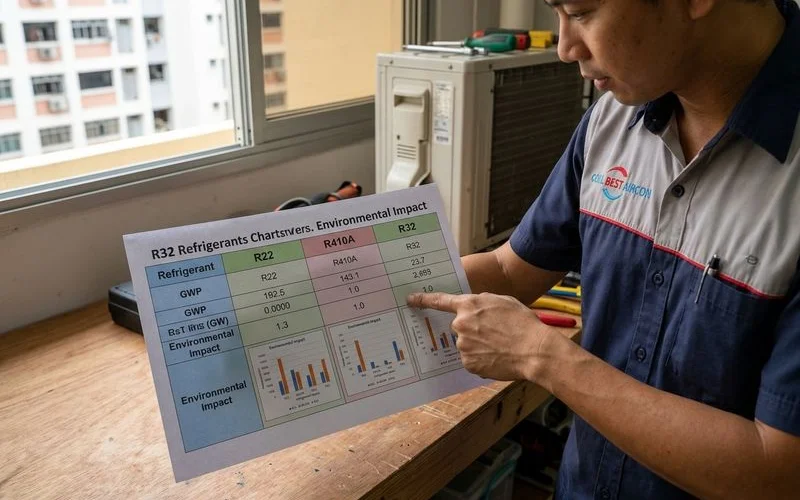
We compiled this quick reference guide to help you compare the three main options at a glance.
| Feature | R22 | R410A | R32 |
|---|---|---|---|
| Era | Pre-2010 | 2008 to 2020 | 2018+ |
| Ozone depletion | Yes | No | No |
| GWP | 1,810 | 2,088 | 675 |
| Energy efficiency | Good | Better | Best |
| Operating pressure | Lower | Higher | Higher |
| Availability | Declining | Abundant | Growing |
| Top-up cost | S$100 to S$180 | S$80 to S$180 | S$100 to S$200 |
| Flammability | Non-flammable | Non-flammable | Mildly flammable |
| Future viability | Phase-out by 2030 | Available long-term | Preferred long-term |
How to Find Out Which Gas Your Aircon Uses
If you are unsure which refrigerant cools your home, finding out takes only a few minutes. Our experts recommend checking these specific spots.
- Inspect the outdoor compressor: Top brands like Daikin and Mitsubishi usually place a silver specifications sticker on the right-side panel listing the exact gas type.
- Review the user manual: The technical specifications page will explicitly state the required refrigerant.
- Open the indoor unit: Some manufacturers print the gas type on a hidden label just beneath the washable front filters.
- Consult your technician: An experienced professional can identify the required gas simply by reading your machine’s model number.
As a general timeline guide for Singapore properties:
- Installed before 2010: Almost certainly R22.
- Installed 2010 to 2017: Most likely R410A.
- Installed 2018 or later: Check the sticker, as it could be R410A or R32.
Gas Top-Up: What You Need to Know
Regardless of your specific unit, the physics of air conditioning remain the same.
Why Gas Gets Low
Refrigerant does not naturally burn off or get consumed over time. It circulates infinitely in a tightly sealed copper loop. If your gas level drops, you definitely have a leak somewhere in the system.
Common failure points include:
- Degraded joints in the copper piping network.
- A loose service valve on the outdoor compressor.
- Micro-corrosion on the indoor evaporator coil.
- Worn-out rubber seals inside the compressor.
Should You Just Top Up?
Adding new gas will restore your cooling temporarily. We warn clients that if the core leak remains unfixed, that expensive new gas will simply escape again.
For tiny, slow leaks, an annual top-up might make financial sense for an older unit. For larger drops in pressure, the gas top-up process must include a proper electronic leak detection test. Skipping the repair means your money literally evaporates into thin air.
Signs You Need a Gas Top-Up
Your system will usually give you clear warning signs before it fails completely.
- The room feels warm because the unit is not cooling properly despite clean filters.
- Thick white ice forms on the copper pipes connecting to your indoor blower.
- The outdoor fan spins loudly, but the indoor vents only blow room-temperature air.
- You hear a faint hissing sound coming from the unit while it runs.
You can read more about the signs your aircon needs servicing to catch these issues early.
Should You Upgrade from R22 to a Newer System?
If your home still relies on R22, you face a tough choice between ongoing maintenance and a full replacement. We use a simple framework to help property owners decide.
Keep Your R22 System If:
- The unit is less than 12 years old and cools the room quickly.
- You only need minor top-ups once every two to three years.
- You plan to sell your property or start major renovations soon.
- The annual maintenance cost remains low compared to buying a new machine.
Replace with R32 If:
- The equipment has passed the 12-year mark.
- You require gas top-ups every few months, indicating a severe pipe rupture.
- Major components like the compressor or circuit board are failing.
- Your monthly electricity bills keep climbing due to poor energy efficiency.
A modern R32 unit provides massive long-term value through lower running costs and decades of guaranteed parts availability.
You do not have to shoulder the entire cost alone. The Singapore government currently offers S$400 Climate Vouchers valid until December 2027. All Singaporean households can use these vouchers to heavily subsidize the cost of a new 5-tick energy-efficient system.
Check our HDB aircon buying guide to find the perfect fit. You can also review our installation cost breakdown to plan your budget accurately.
Environmental Considerations
Choosing the right air conditioner significantly impacts Singapore’s national carbon footprint.
Here is how the options rank for sustainability:
- R32 (Best choice): It boasts the lowest GWP at 675 and zero ozone impact.
- R410A (Phased out): It avoids ozone damage but carries a high GWP of 2088.
- R22 (Worst choice): It actively depletes the ozone layer and has a GWP of 1810.
Selecting a new R32 unit represents a powerful environmental upgrade for your home. When you pair this modern gas with a high energy tick rating, you drastically cut your household electricity consumption.
Need a Gas Top-Up or Upgrade Advice?
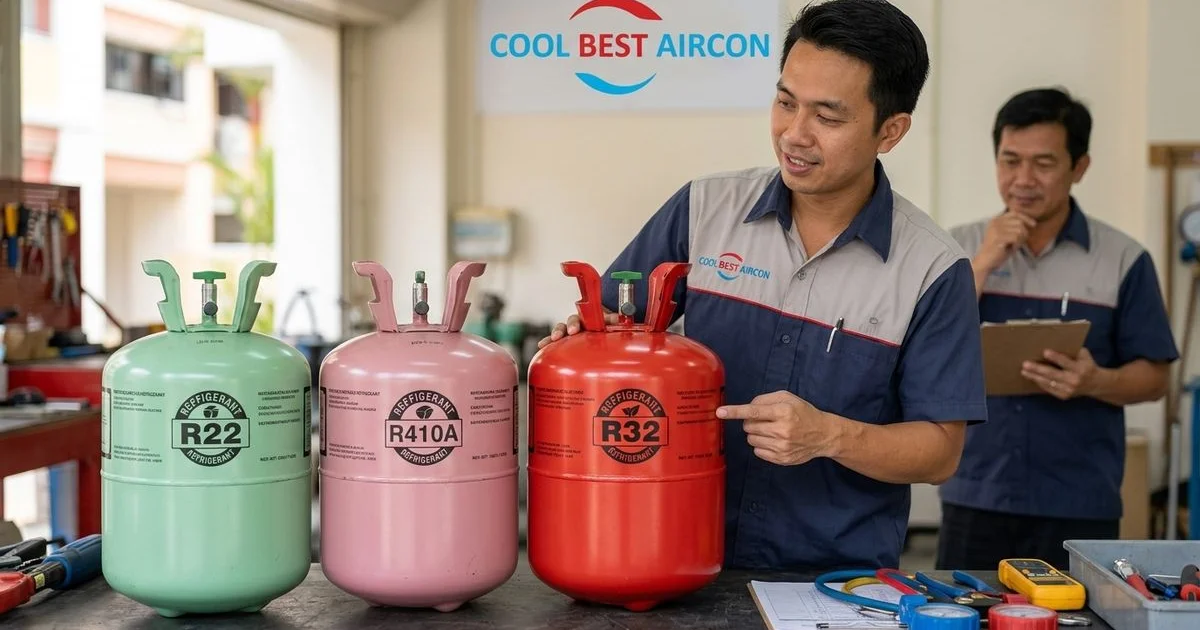
At Coolbest Aircon Servicing, we manage maintenance and repairs for all three major refrigerant types. Specialized technicians stock R22, R410A, and R32 to resolve your cooling issues during a single visit. We always perform thorough leak detection first, ensuring you never pay for a temporary fix when a permanent repair is necessary.
If your aging system costs too much to maintain, an experienced team member will guide you through the most cost-effective replacement strategies. We handle the entire installation process from the initial sizing calculations to the final testing phase. This thorough approach ensures your home stays comfortable without any unnecessary stress.
Understanding the R22 vs R410A vs R32 Gas: What option fits your budget shouldn’t be stressful. You can easily secure a same-day appointment or request a free system upgrade consultation. Contact us at 9182 5233 today for transparent pricing and a comprehensive 90-day warranty.
Mr Chong
Founder & Lead Technician
Mr Chong founded Coolbest Aircon in 2005 with over 18 years of hands-on aircon servicing experience in Singapore.