Have you ever stared at the green ticks on a showroom model and wondered if they actually translate to lower electricity bills? From what we see in the field daily, those National Environment Agency energy labels are the dividing line between standard cooling and true financial savings. Coolbest Aircon Servicing was founded with a mission to deliver reliable, high-quality cooling solutions to communities across Singapore at affordable prices.
Our technicians constantly help property owners decode these labels to maximise their budget. The recent 2025 regulatory updates have completely transformed the market.
Understanding Aircon Energy Tick Ratings in Singapore is now a mandatory step for a smart purchase.
We will break down exactly what the current data tells you. Let us explore how these numbers impact your SP Group bill and share a few practical ways to secure the best long-term value.
What Is the NEA Energy Label?
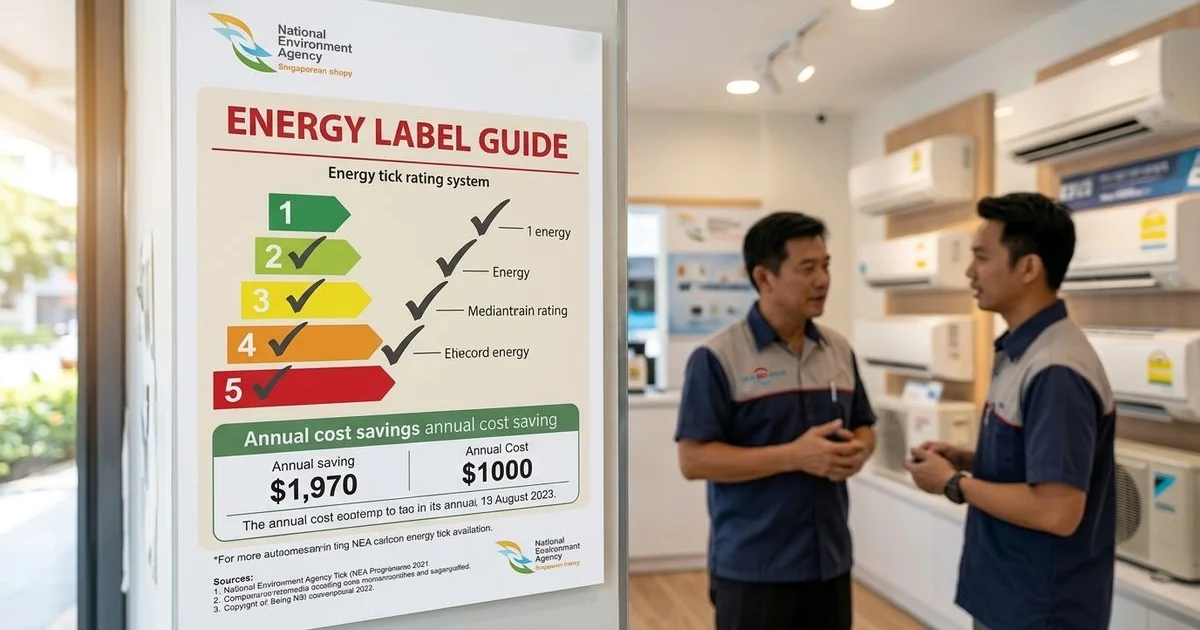
The National Environment Agency Mandatory Energy Labelling Scheme requires all air conditioners sold locally to display an efficiency rating. This system provides consumers with standardised metrics to compare the performance of different models. Our installation records show that buyers who ignore this label often regret their choice when their first utility bill arrives. The scheme covers single-split and multi-split air conditioning systems commonly found in HDB flats and private condominiums.
Big changes took effect on April 1, 2025. The National Environment Agency raised the Minimum Energy Performance Standards significantly. We remind all customers of these current legal baselines for new installations:
- Multi-split systems require a minimum of five ticks.
- Single-split systems require a minimum of four ticks.
- Portable air conditioners now fall under the scheme with strict minimum efficiency levels.
These strict new rules ensure that outdated, energy-draining units are no longer sold to unsuspecting consumers.
Reading the Energy Label
The sticker contains several critical pieces of information for buyers. Here is exactly what each element represents.
The Tick Rating (1 to 5 Ticks)
The most prominent feature is the green tick rating. Our team advises clients to view these ticks as a direct indicator of technological advancement. The system ranks models from one to five.
| Ticks | Classification | Market Reality in 2026 |
|---|---|---|
| 1 tick | Minimum | Obsolete for new split systems |
| 2 ticks | Below average | Phased out for primary residential use |
| 3 ticks | Average | Common in older existing setups |
| 4 ticks | Good | The new baseline for single-splits |
| 5 ticks | Excellent | Mandatory for new multi-split systems |
More ticks indicate less electricity consumed for the exact same cooling output.
A 5-tick unit does not cool a room better than a 1-tick unit. Both machines chill your bedroom to the identical target temperature. We want to clarify that a 5-tick unit simply wastes far less power during the process.
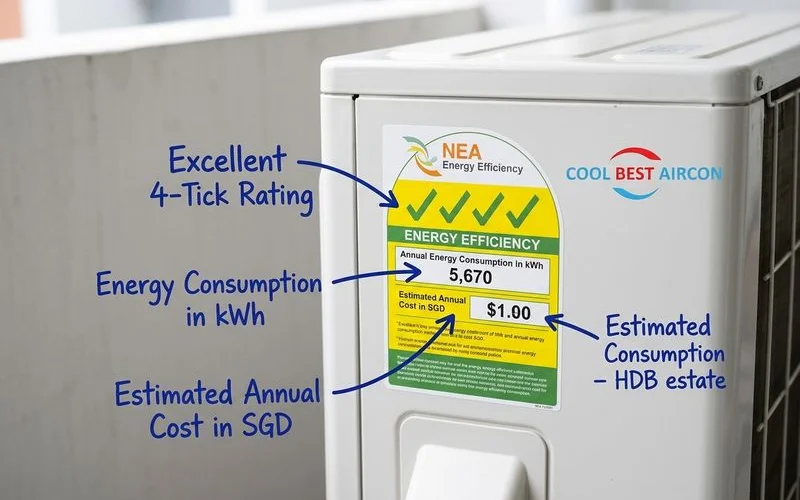
Annual Energy Cost
Below the tick rating, the sticker shows the estimated annual energy cost in Singapore dollars. This figure is calculated using standard testing conditions. Our energy audits reveal that this number is highly accurate for relative comparisons. The calculation relies on an assumed usage pattern of 1,600 hours per year. It also uses the prevailing electricity tariff rate at the time of labelling.
While your actual expenses will differ based on daily habits, the relative difference between models remains constant. If Model A shows S$320 per year and Model B shows S$450, Model A will always be cheaper to run.
Energy Efficiency Ratio (EER) or COP
Some displays feature the Energy Efficiency Ratio (EER) or Coefficient of Performance (COP). These technical metrics reveal how much cooling the unit produces per single unit of electricity. We use these precise numbers when comparing two top-tier models for commercial clients.
- EER is measured in BTU/Watt, where a score above 12 is excellent.
- COP is measured as a ratio of cooling output to electricity input.
- Modern 5-tick units like the Daikin iSmileEco series regularly achieve superior COP ratings by using R32 refrigerant.
For most residential consumers, the tick rating provides sufficient data for comparison.
Cooling Capacity
The label clearly states the unit’s cooling capacity in kilowatts (kW) or BTU/hour. This number dictates the specific room size the appliance is designed to handle. Our sizing calculations prove that matching capacity to room volume is critical for comfort. An undersized 5-tick unit will run continuously and fail to deliver the promised energy savings.
Understanding Aircon Energy Tick Ratings in Singapore: The Real Cost Differences
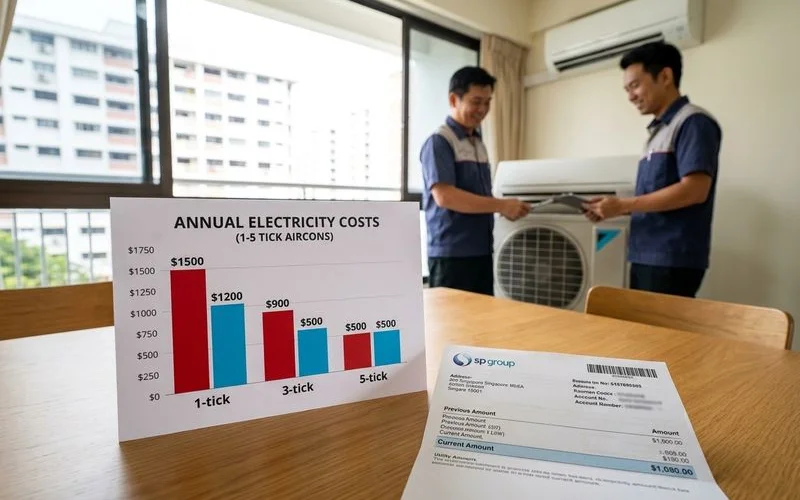
Let us translate these ratings into actual money using realistic local usage patterns. The SP Group electricity tariff fluctuates, sitting at roughly 29.11 cents per kWh inclusive of GST in the first quarter of 2026. We calculate your potential expenses using these current real-world figures.
Annual Electricity Cost by Tick Rating
These estimates are based on a 9,000 BTU unit running approximately eight hours per day for typical bedroom use.
| Tick Rating | Estimated Annual Cost | Savings vs 1-Tick |
|---|---|---|
| 1 tick | S$650 to S$700 | Not applicable |
| 2 ticks | S$520 to S$580 | S$120 to S$130 |
| 3 ticks | S$420 to S$470 | S$230 to S$240 |
| 4 ticks | S$340 to S$380 | S$310 to S$320 |
| 5 ticks | S$280 to S$320 | S$370 to S$380 |
A 5-tick unit saves approximately S$370 per year compared to a 1-tick unit of the identical capacity. Our long-term data shows that over a 15-year lifespan, this single unit generates up to S$5,550 in pure electricity savings.
For a Multi-Unit System
The financial benefits multiply with every indoor unit attached to the compressor. Consider the impact on a standard System 4 setup for a four-room flat. We frequently replace older configurations and track the immediate drop in utility bills.
| Tick Rating | Annual Cost (4 units) | Savings vs 1-Tick |
|---|---|---|
| 1 tick | S$2,400 to S$2,800 | Not applicable |
| 3 ticks | S$1,500 to S$1,800 | S$900 to S$1,000 |
| 5 ticks | S$1,000 to S$1,300 | S$1,400 to S$1,500 |
A System 4 with 5-tick units saves S$1,400 to S$1,500 per year compared to an outdated 1-tick system. That translates to well over S$100 remaining in your bank account every single month.
How Tick Ratings Are Determined
The rating originates from rigorous laboratory testing defined by the ISO 5151 standard. The assessment measures cooling capacity alongside power input at specific rated conditions. Our engineers trust the Cooling Seasonal Performance Factor (CSPF) used in modern evaluations, as this precise ratio determines the final efficiency classification.
The authorities update these thresholds periodically to reflect advancements in manufacturing. A model that qualified as a 5-tick unit in 2015 might only rate as 3 ticks under the 2026 standards. We strongly recommend comparing appliances using the same generation of labelling. A brand new 4-tick system will frequently outperform a decade-old 5-tick installation.
Tick Ratings and Inverter Technology
All modern units with superior ratings rely heavily on inverter compressor technology. This engineering choice is the fundamental reason behind their high efficiency scores. Our repair crews rarely see non-inverter systems in newly renovated homes today.
How Inverter Technology Improves Efficiency
A traditional non-inverter compressor operates in a rigid binary mode. It either runs at maximum speed or shuts off completely. This constant start-stop cycling wastes immense amounts of power. Starting a heavy compressor requires a massive electrical surge, similar to a car burning extra fuel at a traffic light.
An inverter compressor takes a much smarter approach by continuously adjusting its speed. It rarely turns off completely and simply slows down to match the cooling demand. We have observed that this smooth variable operation provides three massive benefits:
- It eliminates expensive start-up energy surges.
- It maintains a perfectly consistent temperature for better sleep comfort.
- It uses 30 to 50 percent less electricity than equivalent non-inverter units.
Virtually all top-tier units, like the Mitsubishi Electric Starmex series, are inverter models. If you spot a unit priced suspiciously below market value, verify the compressor type immediately. The initial discount will vanish quickly due to bloated monthly utility statements.
How Tick Ratings Affect Your Purchase Decision
The initial price tag on a premium system is undeniably higher. Smart property owners know to evaluate the total cost of ownership. Our sales consultants always map out the payback period for cautious buyers.
The Upfront Cost Premium
Here is a realistic look at the price difference versus the expected returns.
| Comparison | Price Premium | Annual Savings | Payback Period |
|---|---|---|---|
| 3-tick vs 2-tick | S$200 to S$400 | S$100 to S$130 | 2 to 3 years |
| 4-tick vs 3-tick | S$300 to S$500 | S$80 to S$100 | 3 to 5 years |
| 5-tick vs 4-tick | S$300 to S$500 | S$60 to S$80 | 4 to 6 years |
| 5-tick vs 2-tick | S$800 to S$1,200 | S$240 to S$260 | 3 to 5 years |
The payback period represents the time required for electricity savings to cover the initial upgrade expense. Since quality systems last 10 to 15 years, you will enjoy up to a decade of pure profit after breaking even.
The S$400 Climate Voucher Advantage
The financial math improved significantly for local residents recently. The government enhanced the Climate Friendly Households Programme on April 15, 2025. We are thrilled that all HDB and private property households can now claim S$400 in Climate Vouchers. These digital vouchers are valid until December 31, 2027.
This S$400 subsidy applies directly to the purchase of qualifying 5-tick air conditioners. Using this voucher instantly eliminates the premium you would normally pay for a top-tier model. It effectively makes the most efficient choice the most affordable option on day one.
Our Professional Recommendation
For the humid local climate, a 5-tick multi-split system is the only logical choice for primary residences. The mandatory regulations and the available government subsidies make the decision straightforward. We advise against buying lower-tier units for any space used more than a few times a year.
Here is why a top-tier upgrade is essential:
- The S$400 voucher offsets the initial purchase price.
- Lower running costs provide a fast return on investment.
- Modern units use eco-friendly R32 refrigerant with a lower Global Warming Potential.
If you need guidance selecting the ideal brand, read our Daikin vs Mitsubishi comparison. You can also consult our detailed HDB aircon buying guide for specific layout advice.
Maintaining Your Tick Rating’s Promise
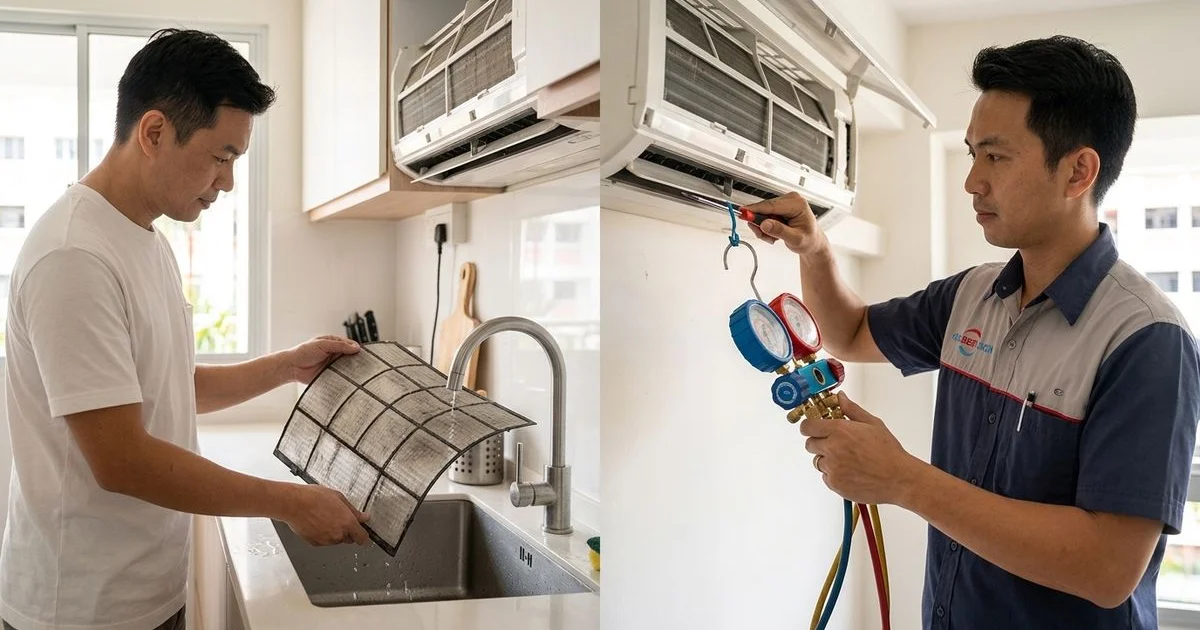
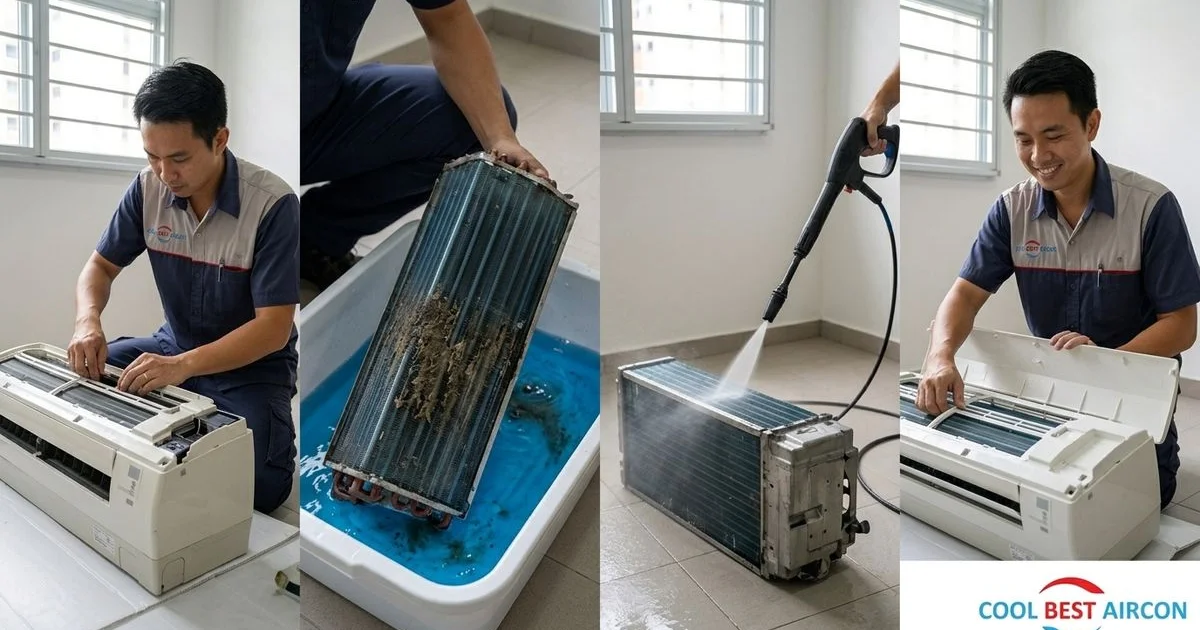
A premium rating guarantees nothing if the machinery is neglected. A dirty evaporator coil will force a 5-tick system to consume as much power as a basic 3-tick model. Our maintenance logs show that efficiency drops by roughly five percent for every year of skipped maintenance.
The official label rating relies on clean coils and perfect refrigerant levels. As dust, grime, and stubborn mould accumulate inside the chassis, performance suffers. The blower pushes less air through the clogged components, forcing the compressor into overdrive.
Routine care is the only way to protect your investment. Booking a general servicing every 3 months keeps the critical components clear. Scheduling a thorough chemical wash every 12 to 18 months restores the original factory performance. We have a complete breakdown of how servicing reduces electricity bills with exact financial metrics.
The Installation Material Warning
There is an insider secret many budget contractors hide. A high-efficiency unit will underperform if installed using thin, substandard copper pipes. Our senior technicians always insist on upgraded insulation and premium piping to prevent condensation leaks. Skimping on installation materials is a guaranteed way to ruin a perfectly good 5-tick investment.
Checking Your Current Unit’s Rating
You might be wondering if your current setup is quietly draining your wallet. Finding out the true efficiency of your existing hardware takes only a few minutes. We suggest checking these four common locations to find the truth.
- Check the front or side panel of the indoor blower for the physical sticker.
- Locate the model number stamp, then verify it against the official online database.
- Review the specification pages in your original user manual.
- Ask your technician to verify the classification during your next scheduled appointment.
If your hardware is older than a decade, the repairs will soon outweigh the value. You must consider whether upgrading to a new, efficient system is the smarter financial move. Our cost analysis proves that lower running costs and the current voucher subsidies make replacement highly attractive.
Key Takeaways
- The April 2025 regulations require all new multi-split systems to be 5-ticks.
- Every extra tick reduces electricity usage and lowers your SP Group statements.
- The S$400 Climate Voucher is available until December 2027 for qualifying 5-tick purchases.
- Modern R32 refrigerant units boast a much lower Global Warming Potential than older R410A models.
- Consistent servicing prevents dirt accumulation from destroying your high-efficiency performance.
- Undersizing or using cheap copper pipes will negate the benefits of a premium model.
Do you need help understanding the new efficiency standards for your home or office?
Clearly Understanding Aircon Energy Tick Ratings in Singapore protects your wallet from rising electricity costs.
Contact Coolbest Aircon at 9182 5233 for honest advice. We will calculate your specific heat load and match you with the perfect system for your budget.
Coolbest Team
Coolbest Aircon Editorial Team
The Coolbest Aircon team shares practical tips from our 18+ years of air conditioning service experience in Singapore.